My dad is responsible for most of my early gaming sins. The dodgy bootleg copies, the late nights, the completely unjustifiable amount of time spent staring at a flickering monitor in the dining room. And somewhere in the middle of all that, around 1992 or so, he pointed me at an old office computer he'd dragged home from work and said something to the effect of "have a go at that."
What I found was Gorillas.BAS. I was maybe eight or nine. I had absolutely no idea what DOS was, what QBasic was, or why two pixelated apes were lobbing explosive fruit at each other across a skyline. Didn't matter. I was immediately, completely hooked, and for the next hour, so was my sister, which tells you everything you need to know about how accessible this thing was.
So What Even Was It?
Developed by IBM and bundled with Microsoft's MS-DOS as part of the QBasic programming suite, Gorillas.BAS was officially a sample program. A teaching tool. Something to show budding young programmers what a few hundred lines of BASIC could actually do. In practice, it was an absolutely moreish two-player artillery game that ate hours you didn't know you had and made you deeply, irrationally competitive with whoever happened to be sitting next to you.
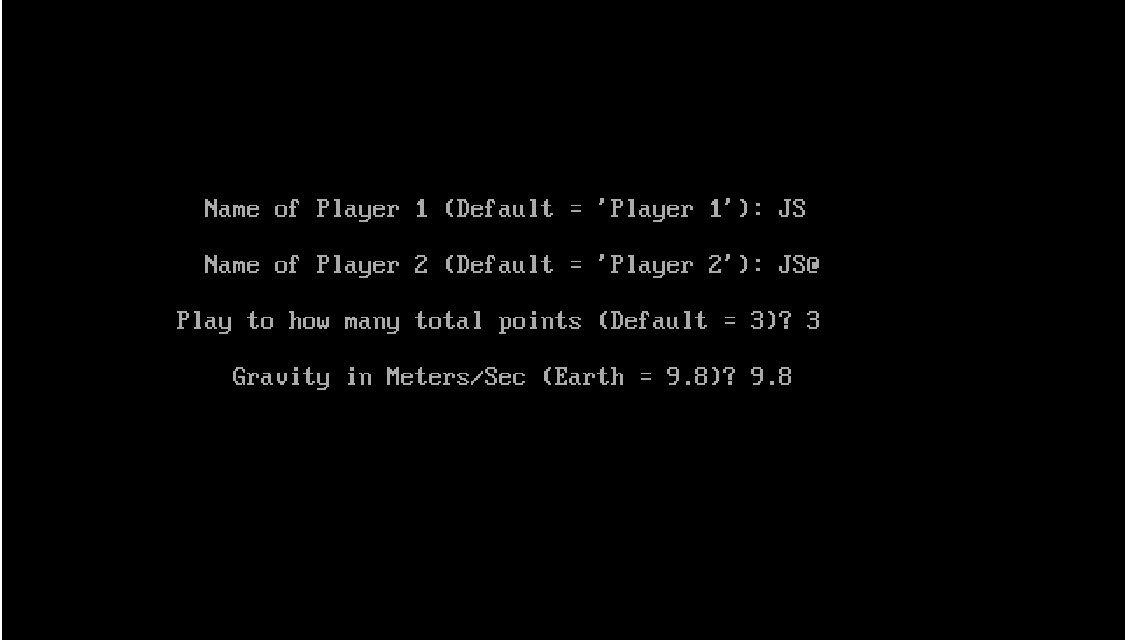
QBasic, short for "Quick Beginners All-purpose Symbolic Instruction Code," was a programming environment and interpreter for the BASIC language, developed by Microsoft and bundled with MS-DOS in the early 1990s. Designed as a learning tool, QBasic provided an accessible way for users to write and run BASIC code without requiring advanced knowledge of programming. It featured a user-friendly editor with syntax highlighting and debugging tools. QBasic launched with two sample games: Namely (this) Gorillas, and Nibbles, a classic snake game where the player navigates a growing snake around obstacles to collect points. These games showcased QBasic's potential and introduced many to coding basics through fun, interactive examples.Two gorillas. Skyscrapers. Bananas. That's your lot. You typed in an angle, typed in a velocity, factored in the wind (which the game cheerfully changed every round to keep you honest) and watched your banana arc through the blocky sky. Hit your mate's gorilla, you win the round. Miss, and you handed the keyboard over and tried not to look smug about it. Simple enough that an eight-year-old could pick it up in minutes. Deep enough that you were still arguing about optimal launch angles twenty rounds later.

The Bit Where I Pretend There's Strategy Involved
There was, actually. That's the thing about Gorillas: it looked like nothing, but the physics underneath had a bit going on. Wind direction and speed, the arc of the throw, the height and position of randomly generated buildings. Every round reshuffled the deck. A low-rise between you and your target one game, a skyscraper canyon the next. Teachers apparently used it in classrooms as a sneaky intro to trigonometry. I can confirm that it did not make me better at maths. It did make me better at shouting "TOO HIGH" at my sister, which is arguably more useful in day-to-day life.
What it actually taught you, without you noticing, was iterative thinking. You'd overshoot by miles, note the wind, adjust, overshoot again slightly less, adjust again. It was basically the scientific method with added primates. There's something quietly clever about a game that makes you feel like you're improving even when you're still mostly sending bananas into the void.

Visually, it was exactly what you'd expect from a BASIC program running on MS-DOS. Blocky skyline. Purple gorillas the size of small thumbnails. A banana rendered in maybe twelve pixels. And yet, and I mean this sincerely, it had personality. The buildings were randomly generated each round, so no two games looked quite the same. The gorillas stood there with this daft self-satisfied posture, arms slightly raised, like they were already celebrating. It was rudimentary, but it had character, which is more than you can say for a lot of things with far better specs.

The Sound of One Banana Exploding
The audio was, charitably, minimal. The title screen opened with dancing gorillas, arms flailing in that particular way that suggested the programmer had never actually seen a gorilla dance but had given it a solid go, accompanied by a little PC speaker ditty that lodged itself permanently in your brain whether you wanted it to or not. Thirty-odd years on and I can still hum it. I've tried to stop. It doesn't work.
In-game it was mostly silence, punctuated by a crunching explosion when a banana connected and a jaunty little victory jingle while your gorilla did its triumphant shuffle and your opponent's was vaporised in what can only be described as a fruit-based nuclear event. No voice acting. No ambient soundtrack. Just the hiss of the PC fan and the sound of someone about to demand a rematch.
It shouldn't have worked as well as it did. But there was something about the contrast, the total silence of watching your banana arc and the anticipation of it, then the crunch of impact, that made a clean hit feel genuinely satisfying in a way a lot of more sophisticated games don't manage. You felt it. On a beige box, through a tinny little speaker. You felt it.
Why It Actually Mattered
Gorillas wasn't sold. There was no box art, no review in PC Zone, no cover disc bundled with PC Format. It just came with the operating system, sitting quietly in the QBasic folder, waiting to be found by whoever was bored enough to go looking. And because of that, millions of people stumbled onto it in exactly the same accidental way I did, sitting at a machine they didn't fully understand, poking around in directories, finding something unexpected that turned out to be genuinely brilliant.
That's a harder trick to pull off than it sounds. Most pack-in software is forgettable filler, the digital equivalent of a free pen with a magazine. Gorillas became a cult classic entirely on the strength of being good. No marketing. No hype. Just word of mouth filtering across offices and school computer labs and family living rooms, passed from one bored person to the next like a decent secret. "Load up QBasic. Then type GORILLAS. Trust me."
It also, quietly and without any particular fanfare, introduced a generation of kids to the idea that code could do something fun. You could look at the source, it was right there, readable, editable, and see how the banana's arc was calculated, how the wind value was applied, how the collision detection worked. Some people tinkered. Changed the gravity. Adjusted the building heights. Made the bananas enormous. It was probably the first time a lot of people thought "I wonder what happens if I change this number" and actually found out. That's not nothing.



The Longer Shadow
The artillery game genre is older than most people realise. Text-only simulations in the late '70s. Human Cannonball on the Atari 2600 in 1979, which swapped the military framing for a circus act but kept the same core loop: angle, force, try not to miss embarrassingly. The genre has always been about that particular tension between simplicity and depth, the feeling that mastery is just a few more goes away.
Gorillas is the one that stuck for a generation of PC users, and its DNA is easy enough to trace. Worms is the obvious heir, same turn-based lobbing energy, more limbs, funnier accents, and the good sense to give players a bazooka when the banana metaphor had run its course. Liero, Hogs of War, even the scrappier modern indie artillery games are all downstream of the same basic formula: two opponents, something to throw, physics that make you feel clever when it works and a complete mug when it doesn't. The formula hasn't really needed updating. Gorillas basically got it right first time.
There's something almost annoying about that, if you think about it. A sample program knocked together to demonstrate a beginner's coding environment, included free with an operating system, played on machines that weren't even really meant for gaming, and it's still a more satisfying two-player experience than a lot of things you'd pay full price for today.
What none of its successors quite replicate is the specific texture of playing Gorillas the way most of us did, huddled around a monitor with someone you know, passing the keyboard back and forth, the CRT throwing pale light across the room while the rest of the house got on with its evening. That's not a design thing. That's just time, and circumstance, and you can't port either of them.
Gorillas.bas Release Details
Useful Links
- Gorillas (video game) - Wikipedia
- Microsoft GORILLAS.BAS - Now on your browser!
- Qbasic - Gorillas | ClassicReload.com
- GORILLAS QBASIC : Microsoft : Free Download, Borrow, and Streaming : Internet Archive
- gorillas/gorillas.bas at master · GorillaStack/gorillas · GitHub
- QBasic Gorillas (DOS) - Video Game Music Preservation Foundation Wiki