Eleven years old, school’s out, dining room to myself, and someone had left a PC game on the desk. That’s essentially the entire origin story of my relationship with Big Red Racing. No prior research, no recommendation from a magazine, no older sibling pointing me in the right direction. Just a box, a disc, and about four hours that disappeared without explanation.
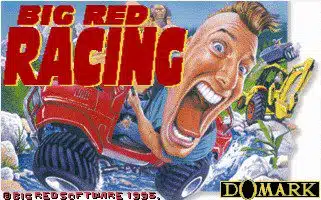
Released in 1995 by Big Red Software and published by Domark, Big Red Racing was a racing game in the same way that a bouncy castle is a form of architecture. Technically accurate. Missing the point entirely.
What Even Was This
The premise was simple enough. You picked a vehicle, you raced it around a track, you tried to finish first. That part was conventional. Everything else was not. The tracks ran through jungles, snowfields, deserts, and locations that didn’t obviously correspond to any real geography. The vehicles included monster trucks, hovercrafts, and go-karts, none of which handled in ways that bore much resemblance to how vehicles actually handle. The physics were their own thing entirely, governed by rules that seemed to be made up on a per-jump basis. An inflatable rubber duck appeared at some point. It was that kind of game.
The Tracks
The courses were the best thing about it. They weren’t circuits in any traditional sense, they were environments, each one stuffed with ramps, shortcuts, obstacles, and bits of scenery that had no obvious reason to be there but which you were extremely glad were. One track had lava. One had a section you could only navigate properly by going completely the wrong direction first. They were designed with the specific energy of someone who’d been told to make racing levels and had decided to interpret that as loosely as possible.
Multiplayer, on the same machine with someone else crammed in next to you, was where the track design really showed its worth. You weren’t really racing in any meaningful competitive sense. You were just navigating shared chaos, occasionally deliberately sending each other off cliffs, and laughing at whoever had just driven into the pond for the third time. The winning was almost incidental.
The Graphics, for Better or Worse
They were not impressive, even in 1995. Blocky vehicles, textures that looked like they’d been drawn in Paint, colours that had no relationship to subtlety. But here’s the thing about graphics that are aggressively, confidently their own thing: they age better than graphics that were trying to be realistic and falling short. Big Red Racing never looked realistic. It looked like itself, which meant it still looks like itself now, in a way that’s almost charming rather than embarrassing.

The environments had a particular quality to them, a kind of garish generosity, like someone had been given a colour palette and told to use all of it. Jungle green next to neon orange next to bright sky blue. It shouldn’t have worked. Somehow it did, because the whole thing was so committed to being exactly what it was that you stopped expecting anything else.
The Vehicles
Picking your vehicle in Big Red Racing was less about competitive advantage and more about what kind of chaos you fancied. The monster truck was slow and would flatten most things in its path, which was satisfying in a blunt, uncomplicated way. The hovercraft handled like a shopping trolley with ambitions, sliding around corners and over water with equal indifference to your inputs. The go-kart was fast and completely unmanageable, which made it either the best or worst choice depending entirely on how much you valued control as a concept.
None of them handled well in any conventional sense. All of them were entertaining to drive. The game understood that physics in a serious racing title are there to create challenge and reward skill, but physics in a game like this are there to create situations, and situations were what it was selling.
The Soundtrack of a Fever Dream
The music had absolutely no business being as catchy as it was. Bouncy, slightly manic, the kind of thing that felt like it belonged in a Saturday morning cartoon about racing animals. It matched the on-screen energy so precisely that it’s hard to imagine the game without it now, the way some games are so completely defined by their soundtracks that they become inseparable.
Sound effects leaned into the same register. Crashes were cartoonish. Splashes were exaggerated. Everything had a slightly amplified quality, like the developers had access to a slider marked “more” and had moved it one notch further than strictly necessary on every single element. It worked.
Who Made It
Big Red Software were a British studio with form. Mike Dailly, one of the leads, had been part of the team that created Lemmings at DMA Design before moving on. Simon Pick was also involved. These were people who understood how to make games that were mechanically simple but obsessively playable, and that sensibility runs through Big Red Racing pretty clearly.
Domark published it, later absorbed into Eidos, the company that would go on to publish Tomb Raider the following year. A different kind of game, clearly, but it’s a reminder of how varied the mid-90s PC landscape was, that the same publisher could be putting out both an inflatable duck obstacle course racing game and one of the most influential action titles of the decade within about twelve months of each other.
It wasn’t a massive commercial success. It didn’t get the kind of reviews that made careers or shifted units by the lorryload. But it found the people it needed to find, and those people tended to remember it, which is a different kind of success and arguably a more durable one.
Does It Hold Up
Yes and no, which is probably the honest answer for most games from this era. The core chaos is still there. The tracks are still inventive. The vehicles are still ridiculous. If you go back to it expecting the thing you remember at eleven, you’ll find it, more or less.
What you won’t find is the context. The cramped room, the other person on the keyboard, the particular quality of an afternoon with nothing else demanding your attention. That stuff doesn’t survive in the game files. Big Red Racing was always partly about the circumstances in which you played it, and circumstances aren’t something you can download from MyAbandonware, much as it would be nice if you could.
Still worth playing though. Especially the hovercraft. Especially on the lava track. Especially if there’s someone else in the room who doesn’t mind losing.


More Information about Big Red Racing’s Release
| Release Date | 1995 |
| Platform | MS-DOS / Windows |
| Genre | Racing / Driving |
| Developer | The Big Red Software Company Ltd. |
| Publisher | Domark Software Ltd. Eidos Interactive Limited |